


 |
|
|
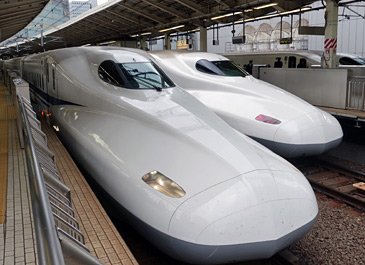
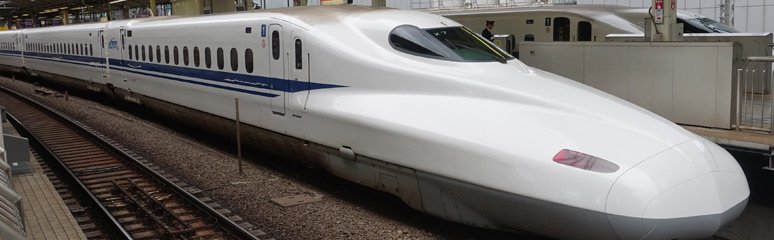
Series N700 shinkansen trains. These link Tokyo, Kyoto, Osaka, Hiroshima & Hakata on the Tokaido & Sanyo line. ►►► Buy a Japan Rail Pass►►► Japan Railpass guide►►► Buy shinkansen train tickets |
|
 ►►► Tours of Japan by train |
|
|
|
Explore Japan by rail
The best way to get around Japan is by train. On this page you'll find an introduction to train travel in Japan, with advice on times, routes, tickets and passes.
 Train travel in Japan, an
overview
Train travel in Japan, an
overview
How to check train times & fares
Example journey times & prices
Japan Rail pass guide 2024
Japan Rail Pass or point to point
tickets?
What does a
Japan Rail Pass cover?
How does a Japan
Rail Pass work?
Making
reservations to go with your pass
Regional passes & Seishun 18 Kippu pass
A
suggested 7-day itinerary in pictures
What are Japanese trains like?
Shinkansen
Watch
the video guides
Travel tips: Luggage, WiFi, finding your train
Rules for large suitcases on shinkansen routes
Airport links & other useful info
Useful country information:
currency, dial code...
Finding your way around Tokyo station
Tours of Japan by
train - organised for you
Travel insurance, mobile data, VPN & other
tips
Ferries to & from Japan
Ferries from Japan to
South Korea
Europe to Japan by Trans-Siberian Railway
Useful country information
Train travel in Japan
-
Japan has an extensive and incredibly efficient rail network, you can pretty much assume that trains go almost everywhere you'd want to visit. Japanese trains are clean, comfortable and unbelievably punctual. The average delay to a high-speed shinkansen train is measured in seconds.
-
Train travel in Japan is really easy. Language is seldom a problem, stations have signs & departure boards in English as well as Japanese. You can see for yourself in the travel tips section below.
-
Most Japanese trains are operated by the Japan Railways (JR) Group, which consists of 6 independent regional companies, JR Central, JR East, JR West, JR Kyushu, JR Hokkaido & JR Shikoku. Since 2006, JR Central, JR East & JR West have been fully privatised, although the other 3 JR companies remain state-owned. In addition to the main JR routes, there are various local routes run by private companies - 'private' in this context means 'non-JR' even though 3 of the 6 JR companies are now privately-owned.
Maps of the rail network
How to check train times & fares
-
To check train times & fares in Japan on both JR & private companies, use world.jorudan.co.jp/mln or japantravel.navitime.com/en/area/jp/route.
-
Tip: Japanese train fares for Shinkansen, Express & Limited Express trains consist of a basic fare + a reserved seat fee or unreserved seat fee for that type of train. For example, Tokyo to Kyoto by shinkansen is ¥8,360 basic fare + ¥4,960 shinkansen unreserved seat fee = total fare ¥13,320. If you wanted a reserved seat, it would be ¥8,360 + ¥5,610 = ¥13,970. Don't make mistakenly think the fare is only the ¥8,360!
-
To buy tickets, see the how to buy tickets section.
The classic network
-
Japan's railways were originally built to narrow gauge with the rails 3' 6" apart, and today a comprehensive network of these lines covers the whole country, linking cities, towns and even villages, see a rail map of Japan here. Trains on the classic network are usually categorised as local, rapid, express or limited express, with the latter two categories requiring an express or limited express seat fee on top of the basic fare. Much of the network is electrified, and even on narrow gauge tracks, smart modern limited expresses can travel at over 80mph.
Shinkansen high-speed lines
-
Key Japanese cities are linked by bullet train, or to use their proper name, shinkansen which simply means new trunk line.
Shinkansen are high-speed lines built from 1964 onwards to standard gauge with rails 4' 8½" apart and operating speeds of up to 300km/h (186 mph). In major cities such as Tokyo or Kyoto you'll find stations with certain platforms handling standard-gauge shinkansen trains and other platforms signposted as JR Lines used by trains on the classic 3' 6" network.
-
Each shinkansen route has its own name, for example the Tokaido shinkansen.
The Tokaido shinkansen runs westwards from Tokyo to Kyoto & Osaka, extended further west to Hiroshima & Hakata as the Sanyo Shinkansen and further west into Kyushu over the Kyushu Shinkansen. The Joetsu, Tohoku, Hokuriku, Hokkaido, Yamagata & Akita shinkansen routes all run north and east from Tokyo
-
Each Shinkansen route has its own train service names to indicate an all-stations, semi-fast or express train.
For example on the Tokaido & Sanyo shinkansen a Kodama is an all-stations service, a Hikari is semi-fast and a Nozomi is express. The equivalent terms on the Kyushu Shinkansen are Kodama, Sakura and Mizuho.
Ordinary class or Green Car?
-
Japanese trains usually have two classes, ordinary class and green car which is the Japanese term for 1st class.
Green cars are indicated by a green clover symbol next to the entrance door. As you'd expect, green car seating has more leg and elbow room with seats arranged 2+2 across the coach width on shinkansen or 2+1 on the classic network, whereas ordinary class seats are usually arranged 2+3 on shinkansen or 2+2 on the classic network. You may also find the green car carpeted, ordinary cars have synthetic flooring. Not all trains have green car seats, of course. Many local trains and even some all-stations kodama shinkansen only have ordinary class.
-
Travelling in ordinary class is very comfortable, there's absolutely no need to pay extra for green car unless you don't mind the extra cost. On the other hand, the extra leg & elbow room is nice if you can afford it. Indeed, although legroom isn't a problem, I find elbow room in the 2+3 ordinary class seating on most shinkansen is a little tight.
-
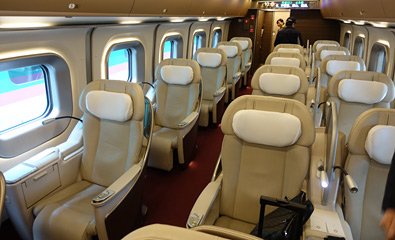
A few premier trains on the Tohoku & Hokkaido shinkansen also offer a top-of-the-range Gran Class in addition to ordinary and green car seats. Gran Class features luxurious reclining leather cradle seats arranged 2+1 across the car width and there's personal steward service of food and drink. Japan Rail Passes cannot be used in Gran Classe at all, so unless you're rich or the Company is paying, I'd forget Gran Class.
Reserved or non-reserved?
-
A typical shinkansen or limited express has reserved cars & non-reserved cars, plus one or more green cars (1st class) which are always reserved.
-
Tickets the non-reserved cars are sold in unlimited numbers, they cannot sell out, but no seat is allocated. You sit where you like on a first-come, first served basis. Most of the time finding a seat is not a problem, but at busy times you'll have to stand if you find all the seats taken.
-
Tickets for the reserved cars cost a little more but come with a allocated seat so you're sure of somewhere to sit. Green cars are always reserved so tickets always come with an allocated seat.
-
The peak travel periods when reserved seats sell out fast and the unreserved seats get very crowded include Golden Week (late April to early May), Obon (mid-August) & New Year (29 Dec to 3 January). Indeed, you may want to time your visit to Japan to avoid these times if you can.
-
Although most trains have unreserved cars including all trains on the Tokyo-Kyoto-Osaka-Hiroshima-Hakata-Nagasaki route, there are a few exceptions where trains are all-reserved with no unreserved cars. These all head northeast from Tokyo, namely Hayate & Hayabusa services on the Tohoku-Hokkaido Shinkansen (Tokyo-Hakodate-Hokuto), Komachi services on the Akita Shinkansen, Kagayaki services on the Hokuriku Shinkansen (Tokyo-Kanazawa). The Narita Express & Kesei Skyliner airport trains are also all-reserved.
Busy periods to avoid
-
The busy periods when reserved seats sell out way ahead and unreserved cars are very crowded are:
- Golden Week between late April & early May;
- Obon in mid-August;
- New Year from 29 Dec to 3 January.
The most crowded trains tend to be the ones heading out of the big cities into the country at the beginning of the holiday and back into the big cities at the end. If you can, time your visit to Japan to avoid these times. Christmas itself isn't such a big issue in Japan.
-
If you can't avoid travelling at these busy holiday periods:
Aim for the less popular first & last trains of the day;
Try booking the slower trains such as the all-stations Kodama shinkansen rather than the faster & busier Hikari or Sakura trains;
Try splitting the booking: If you can't get reserved seats from Tokyo to Kyoto, try Tokyo to Nagoya then Nagoya to Kyoto, that may work;
When using unreserved seats, pick a train that starts at the station you're at, not one which comes from elsewhere, already heavily-loaded.
Example journey times & prices
£1 = 180 yen. $1 = 140 yen.
* Nozomi = fastest Shinkansen stopping pattern.
** Hikari = next fastest train type, Japan Rail Passes can be used.
*** Fare by Nozomi with reserved seat.
Check Japanese train times & fares at www.jorudan.co.jp.
Children aged 0 to 5 travel free, children aged 6 to 11 travel at half fare, children aged 12 and over pay full fare.
Rail fares in Japan are expensive, and if you are an overseas visitor a Japan Rail Pass can be the cheapest way to travel even if you are only planning one return trip from (say) Tokyo to Hiroshima. See the Japan Rail Pass section.
How to buy tickets
-
Option 1, book online at www.baolau.com - JR East, JR Central, JR West Shinkansen, some Limited Expresses
www.baolau.com now sells tickets for the Tokaido, Sanyo, Hokkaido, Tohoku, Akita, Yamagata, Joetsu & Hokuriku Shinkansen, which includes trains between Tokyo, Nagoya, Kyoto, Osaka, Kobe, Himeji, Hiroshima, Yamaguchi, Fukuoka, Niigata & Aomori. They now also sell tickets for some JR East & JR Hokkaido Limited Express trains, although not yet JR Kyushu tickets to Nagasaki.
www.baolau.com is a reliable agency which sells train, bus and ferry tickets for various Asian countries, they now sell Japanese train tickets too, which is good, as Japan Railways don't offer online sales in English, at least not for these routes.
Baolau can book Hikari, Sakura, Kodama trains as well as Nozomi & Mizuho trains.
They allow you to select your seat from a seating plan, so you can make sure (for example) that you get a window seat, or two seats on the 2-abreast side of the aisle, not the middle seat in a row of 3 on the other side of the aisle!
They send you an e-ticket with a QR code which you can either print out or keep on your phone. You then collect a hard-copy ticket at the station from one of the self-service ticket machines, simply by scanning the QR code. You can then board the train.
-
Option 2, book online at 12go.asia - most principal train routes across Japan
Reliable trans-Asia train & bus booking agency 12go.asia now sells tickets for principal routes in Japan too. It sells in various currencies including £, € & $. However, at the time I write this it can't book Green Car (1st class).
-
Option 3, order shinkansen tickets from www.klook.com .
A well-known online agency with an easy-to-use interface which sells shinkansen tickets for major routes in unreserved, reserved or green car.
-
Option 4, buy at the station
You can of course buy tickets at the station, either at the staffed counters or using ticket machines, these have a touch screen with an English language facility. There are many trains & seats, so buying at the station is unlikely to be a problem unless you hit one of the busy national holiday periods - and even then, you can always travel in the unreserved seats cars.
For advice on airport trains, see the Haneda or Narita sections below.
-
Consider a Japan Rail Pass
As rail fares in Japan are expensive it's worth buying a 7-day Japan Rail Pass, see the Japan Rail Pass section below.
How to buy local tickets
-
Use the self-service ticket machines. At any main station you'll find a row of these with a big network map above them near the ticket gates onto the local platforms, see the photo in the Tokyo station section below. You'll soon get the hang of buying tickets, like this:
- Look at the big network map on the wall above the machines. Find your destination station & note the fare shown next to it.
- On the touch screen, press English.
- Press the side button for the number of adults/children in your party. For 2 adults & 2 children you have to buy as 2 transactions.
- You'll now see a screen full of possible one-way fares for one adult.
- Touch the fare for your destination. So if the fare shown on the map against your destination is 350, touch the 350 button.
- It'll now show the total cost for the number of adults & children you have selected.
- Enter coins or notes, the machine gives change, but they don't take cards.
Japan Rail Pass guide
 |
|
|
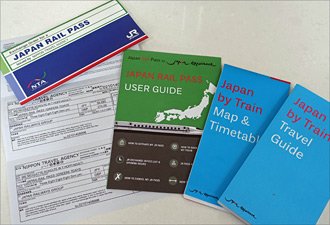
1. Exchange Voucher. When you order your pass online, you are sent an Exchange Voucher (above, on left) plus a handy Japan Rail Pass user guide, a Japan rail timetable and a Japan rail map. The voucher can be exchanged for a Japan Rail Pass at any time in the 3 months after ordering. |
|
 |
|
|
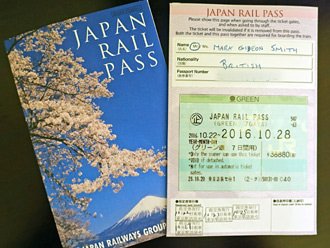
2. Japan Rail Pass. You exchange the voucher for a Japan Rail Pass at any one of 50 designated JR exchange offices in Japan, including Tokyo, Ueno, Shinjuku, Narita International Airport, Haneda International Airport, Kyoto, Hiroshima, Nagasaki. The photo above shows an old-school pass, from 2023 passes are being issued as credit-card-size card tickets which can operate ticket gates. |
-
Japan Rail Pass or point-to-point tickets?
Train fares in Japan are expensive as there are no cheap advance-purchase fares, just one hefty fixed price for each journey. A Japan Rail Pass can save money over point-to-point tickets even for one round trip, if it's a long-distance one. A significant Japan Rail Pass price rise in October 2023 means it's no longer a foregone conclusion, but here are some comparisons after the pass price increase:
A 7-day Japan Rail Pass costs ¥50,000 = £268 or $340.
The normal return fare from Tokyo to Kyoto is ¥27,940 = £150 or $190.
The normal return fare from Tokyo to Hiroshima is ¥39,120 = £210 or $270.
The normal return fare from Tokyo to Nagasaki is ¥52,620 = £290 or $360.
So a 7-day Japan Rail Pass saves money for one round trip from Tokyo to Nagasaki, but not for a round trip from Tokyo to Kyoto. It may be worth buying a Japan Rail Pass for a round trip from Tokyo to Hiroshima if you do one or more side trips as well.
-
How to work out if a pass makes sense
First check Japan Rail Pass prices at www.jrailpass.com. Then use japantravel.navitime.com to check point-to-point fares for the journeys you intend to make.
Remember that the total point-to-point price you'd pay = basic fare + the reserved or unreserved seat fee. A pass covers both of these elements, reservations are free.
-
Big price rise in October 2023
The price of Japan Rail Passes increased significantly in October 2023, we're talking a whopping 68% increase. Check prices online carefully, and check against regular fares as shown above. However, passes are finally valid on the fastest limited-stop Nozomi & Mizuho services, if you pay an extra fee of around ¥4,000-¥6,500 ($27-$44) depending on distance. Before October 2023 you were limited to the second-fastest services, passes were not valid on Nozomi & Mizuho services at all.
-
Green car or ordinary class?
A green class pass is great if you can afford it, but ordinary class on Japanese trains is perfectly adequate, there's no need to pay more if you don't want to. Green car simply gets you more leg and elbow room, and carpet rather than synthetic flooring, that's all.
Personally, I find shinkansen ordinary class seats a little cramped where they are arranged 2+3 across the car width, the 2+2 seats in the green car are much more spacious. On the other hand, if you plan to be spontaneous much of the time and not pre-plan everything you'll end up in the unreserved ordinary class cars, so don't fork out for a green car pass if you're not going to use it.
What does a Japan Rail Pass cover?
-
You can buy a Japan Rail Pass for 7, 14 or 21 days in either ordinary class or green car (1st class).
-
The pass gives unlimited travel on all JR trains across the whole of Japan, including high-speed shinkansen (bullet trains), the local, rapid, express and limited express trains on the classic network and even the Narita Express between Narita Airport & Tokyo and the monorail to & from Haneda Airport.
There are just the following exceptions:
-
You can't use a Japan Rail Pass on lines run by private rail operators, only lines operated by one of the six JR companies. For example, it doesn't cover the Tobu Railway from Tokyo to Nikko, or the Tokyo subway trains which aren't run by JR either.
But it does cover the Narita Express airport train as that's run by JR. It also covers JR local trains in Tokyo & other cities including the useful Yamanote loop line linking Tokyo main station, Ueno, Shinjuku, Shibuya, Shimbashi, Ikebukuro every few minutes, which you can use to get around Tokyo.
-
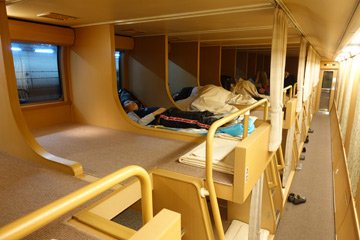
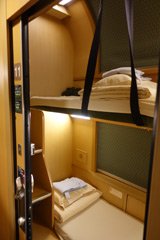
Sleeper trains: There there's only one sleeper train left in Japan, the Sunrise Seto/Sunrise Izumo, but you can use this with a Japan Rail Pass if you either pay the hefty sleeper supplement for a private sleeper - we're talking ¥20,000 per room for a private 2-berth B-type sleeper - or use the open-plan shared nobinobi or 'carpet berths' which are free of charge with a Japan Rail Pass, reservation required. Indeed, if you're on a budget, saving a hotel bill by taking the Sunrise Seto between Tokyo & (say) Himeji is an interesting option!
-
Nozomi or Mizuho shinkansen trains: Until October 2023, Japan Rail Pass holders couldn't use the fastest limited-stop Nozomi or Mizuho category shinkansen trains. You can now use them, but must pay an extra fee, typically ¥4,000-¥6,500 ($27-$44) depending on distance.
-
You'll find more detailed info at www.jrailpass.com.
How does a Japan Rail Pass work?
-
Order your pass & receive a voucher
You order your Japan Rail Pass online at an official pass agency website such as www.jrailpass.com and an exchange voucher is sent by tracked courier to your home address. You'll also get a free Japan rail map and a Japan railways timetable booklet.
You need to buy the pass before you leave home, you can't buy a Japan Rail Pass in Japan.
-
When you get to Japan, exchange the voucher for the pass
When you arrive in Japan, you exchange this voucher for a Japan Rail Pass at any of the JR ticket offices & travel centres designated as a Japan Rail Pass exchange office.
The voucher can be exchanged for a pass any time within 3 months of buying the voucher, so there's no need to specify exact travel dates when you order it.
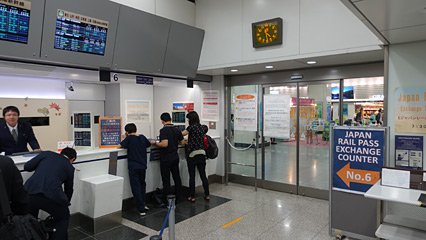
There are Japan Rail Pass exchange counters at around 50 JR stations, including Tokyo's main station which has Japan Rail Pass exchange counters on both the Marunouchi (west) & Yaesu (east) sides of the station, Tokyo's Ueno, Shinjuku, Shibuya, Ikebukuro stations, Narita Airport, Haneda Airport, Kansai Airport, Shin-Osaka, Kyoto, Hiroshima, Nagasaki and even Sakaiminato where (if & when operating) the ferry arrives from Vladivostok.
Tip: The Japan Rail Pass exchange counters at Narita and Haneda airports are usually fairly relaxed places to exchange your voucher. In Tokyo the JR East Service Centre in the historic North Entrance on the quieter Marunouchi (west) side of the station is also a good and relaxed place to exchange your voucher, more relaxed than the Japan Rail Pass counter on the more hectic Yaesu (east) side of the station.
-
When you exchange the voucher, you'll be asked to show your passport and to fill in a simple form with your name and passport number which they incorporate into the pass itself. You'll be asked on what specific date you want the 7, 14 or 21 days to start, this can be any date within the next 30 days - the pass does not need to start on the same day you exchange the voucher for the pass.
For example, in July I booked a flight to Japan for travel in late October. I ordered my 7-day Japan Rail Pass in September. I didn't need to decide in advance exactly what days I would use it, as long as I exchanged the voucher for a pass within 3 months of ordering it. So I could have delayed my visit until November and still used the same voucher. Arriving in Japan on 20 October, I exchanged my voucher for a pass at Tokyo station on 21 October, asking for my 7 days of unlimited travel to start on 22 October.
-
Then ride as many trains as you want! Once you have your pass and your 7, 14 or 21 days of unlimited travel have started, you use as many JR trains as you like, travelling whenever and wherever you like. There is no limit on the number of trains you can take or the distance you can travel - that's what unlimited means.
-
To look up train times, use world.jorudan.co.jp/mln (please let me know if that link stops working). You can also look up train times at japantravel.navitime.com/en/area/jp/route, click Tourist pass and select your type of pass to only see trains for which your pass is valid.
 |
|
|
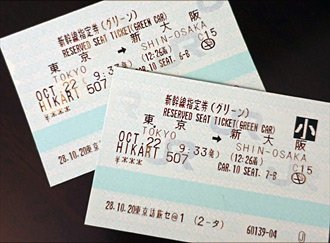
3. Reservations. Reservation are free with a Japan Rail Pass. You get a seat reservation ticket like this for each seat you reserve, stating date, train, car & seat number. |
|
 |
|
|
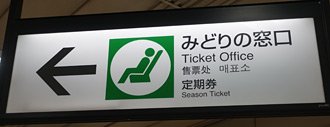
You can make seat reservations at any ticket office shown with the green seat reservation logo. |
Making reservations with your pass
-
Local & Rapid trains: You don't need a reservation to travel on local or rapid trains on the classic network, such trains don't even have seat reservations. Just hop on and show your pass when the conductor comes along. Easy!
-
Unreserved seat cars: Express, limited express and shinkansen trains usually have several non-reserved ordinary class cars, as the name suggests you don't need a reservation to travel in these. Platform announcements, departure boards and platform signs in English will tell you which car numbers these are, and where you should stand on the platform for them - it's all very efficient.
If you are happy travelling in the non-reserved cars you can just get on and sit where you like, and show your pass to the conductor when he comes long. Normally there's little problem finding a seat, indeed you may even be spoilt for choice. But a seat isn't guaranteed, and at busy times of day or at busy holiday periods you may have to stand or sit on your luggage in the aisle if you find all the seats are taken.
-
Reserved seat cars: To be sure of a seat on a shinkansen, limited express or express train, or to sit in a Green Car seat with a Green Car pass, you must reserve a seat in one of the reserved cars.
You are unlikely to have any problem getting the reservations you need, even booking at short notice when you get to Japan, unless you hit a busy holiday period. And even then, you can always use the unreserved cars so you'll never be stranded, although it may be crowded so you may have to stand.
-
Reserving seats at stations: You can reserve seats this free of charge at any JR ticket office or travel centre where you see the green seat reservation symbol. Just show your Japan Rail Pass and passport and ask for a reservation in the class you want on the train you want. You can make reservations at any time right up to a few minutes before the train leaves.
-
Reserving seats using a ticket machine: You can also make reservations using self-service ticket machines, these have an English language facility. Select the rail pass option. Select the number of passengers. Then scan the QR code on your Japan Rail pass and enter your passport number, repeating this for each passenger (so you’ll need their pass & passport numbers). You then enter the starting station, destination, date & time and it will find trains and let you choose seats. It will also let you select oversized baggage seats if available. It’ll issue a seat reservation ticket.
-
You can't make seat reservations before you get to Japan
You can't reserve seats to go with your pass until you reach Japan and can get to a station. There's one key exception: JR East have set up a website for Japan Railpass holders to make reservations on their high speed trains north & east of Tokyo, including the Narita Express and the Joetsu, Tohoku, Hokuriku, Hokkaido, Yamagata & Akita shinkansen, but not the Tokaido, Sanyo or Kyushu shinkansen linking Tokyo, Kyoto, Shin-Osaka, Hiroshima, Hakata, Nagasaki as obviously these aren't run by JR East, but by JR Central & JR West.
To make reservations on JR East services, see www.eki-net.com/pc/jreast-shinkansen-reservation/English/wb/common/Menu (if this link stops working, try www.jreast.co.jp/e/eastpass and please let me know). Seat reservations made using this service must be collected before 21:00 the day before travel or they will be cancelled.
-
Green car seats: Green car (1st class) seats on shinkansen & limited express trains are always reserved, if you sit in a green car seat without a reservation you'll be charged the hefty green car shinkansen reserved seat fee, even if you have a Green Car Japan Rail Pass. So if you have a Green Car pass, either make a reservation to use the Green Car, or if you want to be spontaneous and hop on a train without a reservation, use the ordinary class unreserved cars.
-
Reservation tips
There's no penalty for not using a seat reservation you've made with a Japan Rail Pass. Bad manners not to cancel it perhaps, but if you had a reservation for (say) the 18:45 and decided to leave earlier, you could hop on the 17:45 and sit in the unreserved cars, no problem.
If you know your itinerary, there's no reason why you can't make all the necessary reservations for your trip in one go when you exchange your voucher for the pass. But do the legwork first. Look up each of the trains you want using world.jorudan.co.jp/mln/en then type out a clear written list of reservations specifying date, journey, train number, departure time, class and number of passengers. If it's not too busy, the staff at the Japan Rail Pass counter may work through the list for you, issuing a reservation ticket for each reserved seat. But if it's busy and there's a queue behind you, don't be surprised of they turn you away, asking you to make reservations as you need them at the ticket office. Staff at the JR East Service Centre did all my reservations for me, no problem. But a notice at the Haneda Airport travel service centre said they were only prepared to do reservations for today. Feedback appreciated!
Suggested 7-day itinerary
-
Click here for my recommended itinerary using a 7-day Japan Rail Pass, starting in Tokyo and visiting Kyoto for its temples & geisha district, Himeji for its castle, Hiroshima for its museum and Peace Park and Nagasaki for its history as the only point of contact with the outside world from the 17th to 19th centuries. I think this is the ideal tour for a first visit to Japan!
Buy a Japan Rail Pass
-
You need to buy your Japan Rail Pass before you leave your home country as you can't (generally) buy a pass once you're in Japan.
-
Option 1, buy a Japan Rail Pass at www.jrailpass.com.
Passes can be sent any address worldwide, you can book up to 180 days in advance, prices are shown in various currencies. A reliable agency I've been recommending for some years now.
-
Option 2, buy a Japan Rail Pass at www.klook.com, here's a direct link to their all-Japan pass page.
Passes can be sent any address worldwide, you can book up to 180 days in advance, prices are shown in various currencies. A well-known online agency with an easy-to-use interface, feedback appreciated.
When you buy your pass
1. Exchange Voucher. When you order your pass online, you are sent an Exchange Voucher (above, on left) plus a handy Japan Rail Pass user guide, a Japan rail timetable and a Japan rail map. The voucher can be exchanged for a Japan Rail Pass at any time in the 3 months after ordering.
2. Japan Rail Pass. You exchange the voucher for a Japan Rail Pass at any one of 50 designated JR exchange offices in Japan, including Tokyo main station (2 offices), Ueno, Shinjuku, Narita International Airport, Haneda International Airport, Kyoto, Hiroshima, Nagasaki. The photo above shows an old-school pass, from 2023 passes are being issued as credit-card-size card tickets which can operate ticket gates.
Regional rail passes
Japan East pass, Sanyo pass, Kansai pass
-
There are also regional Japan Rail Passes covering smaller areas.
-
The Japan East Pass covers Tokyo, Nagano, Niigata, Sendai, Morioka, Misawa & Akita.
-
The JR West Pass covers Osaka-Fukuoka and all trains run by JR West, for 7 days.
-
The Sanyo area pass covers an area including Osaka, Himeji, Okayama, Hiroshima & Hakata.
-
The Kansai area rail pass covers Kyoto, Osaka, Kobe, Nara & Himeji and costs only around £15/$23 a day, a pretty good deal.
-
For more information and to buy a pass, see www.klook.com (passes sent to any address worldwide) or www.japan-rail-pass.com.
Seishun 18 Kippu
-
The Seishun 18 Kippu (Youthful 18 Ticket) gives 5 days unlimited travel on Japan Railways' local trains and kaisoku (accelerated local) trains for ¥12,050, about $97 or $20 per day. It's possible to travel all the way across Japan this way, incredibly cheaply, but only using the narrow-gauge local trains.
-
It's sold to both Japanese citizens and overseas visitors of any age (in spite of its name), but only during specific Spring (March-April), Summer (July-September) & winter (December-January) periods.
-
Rather than explain it further here, see this page for details: www.japan-guide.com/e/e2362.html or en.wikipedia.org/wiki/Seishun_18_Ticket or www.jreast.co.jp/e/pass/seishun18.html. Update: Most online info seems to have disappeared, but in March 2024 it's confirmed that the pass still exists if you buy in Japan.
1, 2 & 3-day metro passes for Tokyo
-
Foreign visitors can buy Tokyo metro 24 hour, 48 hour & 72 hour tickets, see www.tokyometro.jp/en/ticket/travel.
If you like, you can buy a 1/2/3 day Tokyo metro pass online in advance at www.klook.com and collect it from the metro ticket machines.
-
You can buy one-day passes covering the Tokyo metro, or Tokyo metro+Toei Subway+JR local trains (called the Tokyo Combination ticket), see www.tokyometro.jp/en/ticket/value/1day.
Shinkansen high-speed trains
Everyone has heard of Japan's bullet train lines, more properly known in Japan as shinkansen which means new trunk line. These are high-speed lines, built to European and North American standard gauge with rails 4' 8½" apart. The first shinkansen was the Tokaido Shinkansen opened in 1964 between Toyo, Kyoto and Osaka, later extended as the Sanyo Shinkansen to Hiroshima, Kobe and Hakata. There are now a whole range of shinkansen lines linking all the most important cities in Japan, including Niigata, Tokyo, Kyoto, Osaka, Hiroshima, Hakata and Kagoshima.
Watch
the video, Tokyo to Hiroshima by shinkansen
Watch the
video: Hiroshima to Nagasaki by shinkansen & Limited Express
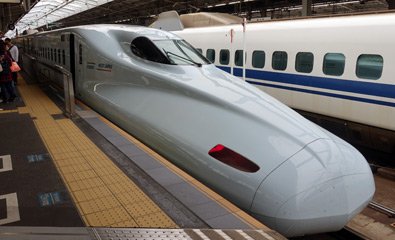
Tokaido & Sanyo shinkansen N700A
These 16-car N700As owned by JR Central & JR West operate the Nozomi and Hikari services on the Tokaido Shinkansen between Tokyo, Kyoto and Shin-Osaka. Many Nozomis and a few Hikaris extend to Hiroshima, Kobe & Hakata over the Sanyo Shinkansen. These trains operate at up to 285 km/h (175 mph) on the Tokaido Shinkansen and up to 300km/h (186 mph) on the Sanyo Shinkansen.
Shinkansen seats are always rotated to face the direction of travel, and all seats come with a drop-down table attached to the seat back in front. If there are four of you, you can rotate one pair of seats to make a face-to-face group of four. There are power sockets (Japanese 2-pin) at all seats on these N700s.
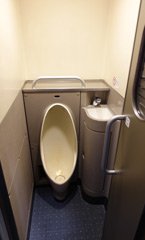
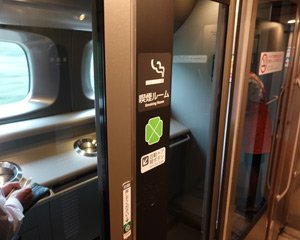
Sanyo & Kyushu shinkansen N700
These 8-car N700 shinkansen trains owned by JR West & JR Kyushu operate the Mizuho & Sakura services on the Sanyo & Kyushu shinkansen lines between Shin-Osaka, Hiroshima, Himeji, Hakata and Kagoshima.
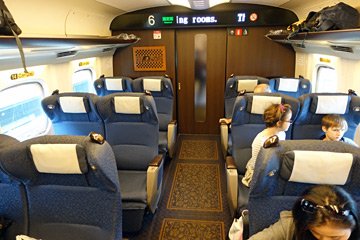
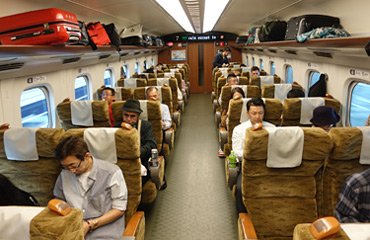
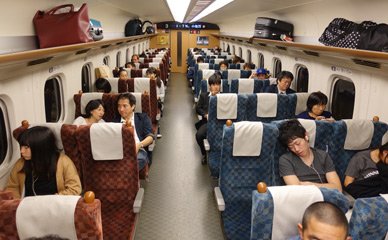
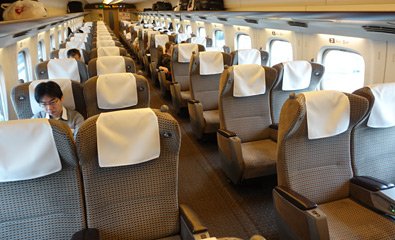
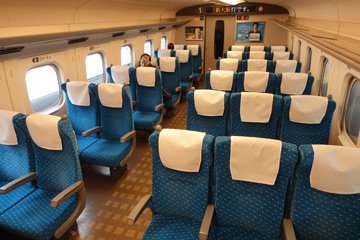
On most shinkansen trains, ordinary class seats are the same whether reserved or non-reserved. But on these particular trains, ordinary class reserved seats (above left) are arranged 2+2 across the car width, much more spacious than the non-reserved cars (above right). An added benefit of reserving a seat!
Joetsu, Tohoku, Hokuriku, Hokkaido, Yamagata & Akita shinkansen
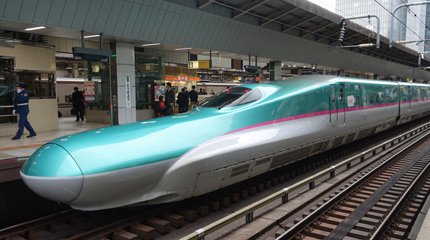
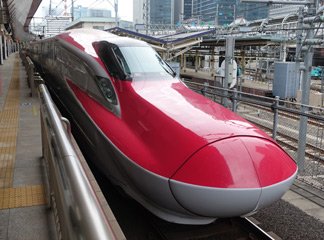
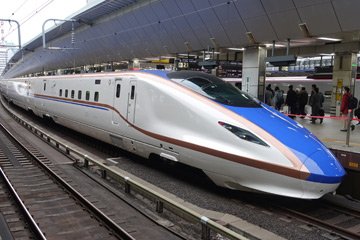
You'll find a range of exotic trains on the Joetsu, Tohoku, Hokuriku, Hokkaido, Yamagata & Akita shinkansen routes heading north & east of Tokyo.
Limited Expresses
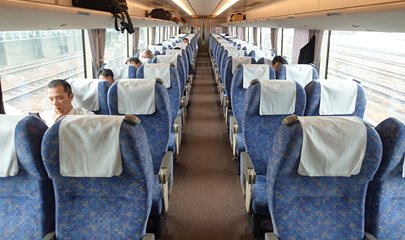
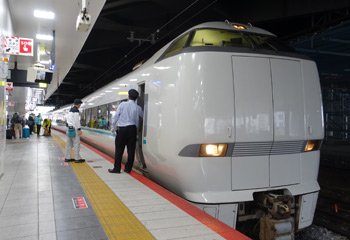
An extensive network of classic 3' 6" narrow-gauge lines covers the whole of Japan taking you to almost every city and town of any size. The fastest trains on the classic network are classified Limited Express, and these train come in all shapes and sizes. Indeed, the classic network often parallels the shinkansen: For example, you can travel between Kyoto, Osaka and Himeji by Limited Express on the classic network just as easily as by shinkansen. Give it a try!
Local & rapid trains
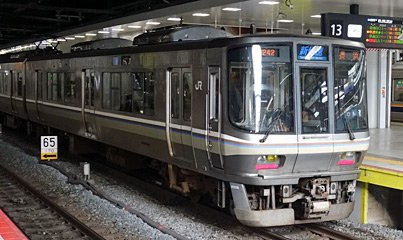
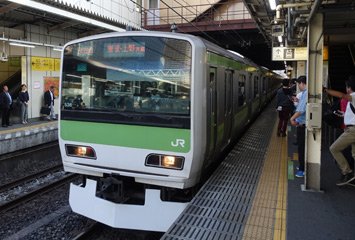
Completing the picture, there are many local & rapid trains on the classic 3' 6" narrow-gauge network, again of many shapes and sizes.
Sleeper trains: See the video
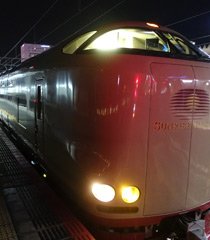
There's now only one sleeping-car train left in Japan, the Sunrise Express. It runs as one combined train from Tokyo to Himeji & Okayama and then splits, the Sunrise Seto heading for Takamatsu on the island of Shikoku and the Sunrise Izumo heading for Izumoshi.
You can use the Sunrise Express at no extra charge with a Japan Rail Pass if you make a reservation for one of the basic nobinobi berths (see the photo below left) or you can pay the room fee to have a private compartment. Expect a private sleeper compartment for one person to cost around ¥8,000 for a B-type single, around ¥7,000 for a similar but slightly smaller B-type solo, or ¥15,000 for a more spacious A-type deluxe single-bed sleeper with washbasin. For two people, it costs around ¥15,000 per compartment in a B-type single-twin with upper & lower berths or ¥16,000 per compartment in a B-type Sunrise twin with two lower berths side by side. Without a pass, you pay the regular fare and limited express extra fare plus these berth costs.
The sleeper train runs on the classic narrow-gauge network, but it can save time compared with daytime shinkansen travel but more importantly it's a unique experience, watch the Sunrise Express video. It could save a hotel bill too! See the official Sunrise Express information page, in Japanese, translatable with Google Chrome, to see photo of each accommodation type and check current berth fees.
Travel tip: Himeji is a popular destination, but the Sunrise Express arrives there very early westbound and leaves late at night eastbound. Remember that with a Japan Rail Pass you can easily double back, leaving or boarding the train an hour away in Okayama at a more attractive time instead. The useful Tokyo-Nagasaki sleeper train is long gone, and the Hokutosei & Cassiopeia sleeper trains between Tokyo & Sapporo disappeared in late 2015/early 2016 with the expansion of high-speed shinkansen services to Hokkaido.
Travel tips
Ticket gates
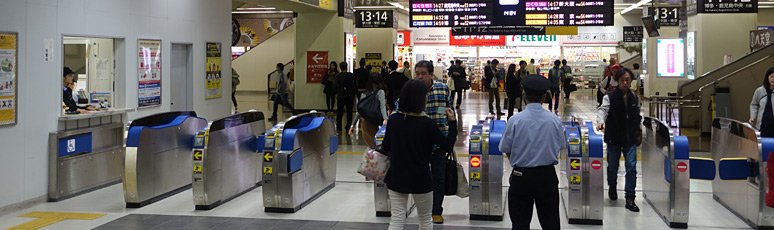
When entering (or leaving) the platform area at any principal Japanese station, you'll need to pass through a set of automatic ticket gates like the ones shown here. To catch a shinkansen train you may need to pass through two sets of gates, the first to access the JR Lines platform area serving the classic network, then another to access the Shinkansen platforms. The gates are usually open by default, they'll spring shut if you try to pass through without a ticket. All gate lines have a staffed side-gate, and if you have an old-style Japan Rail Pass you'll need to use this. Just flash your pass at the side gate and you'll be waved through. However, Japan Rail Passes are now being issued in the same format as normal magnetic-stripe card tickets, and passes in this format will operate the gates.
Finding your platform, train & seat
Many visitors worry about language in Japan, but signs are in both Japanese and English and the system is so efficient and easy to use. The photos below show how easy it is to find the right platform, stand in the right place for your car when the train comes in, and be sure you're getting on the right train.
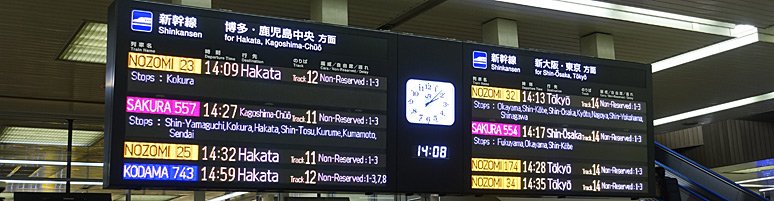
Main departures board at Hiroshima. It alternates between Japanese & English. To the left of the clock, departures towards Hakata. To the right of the clock, departures towards Tokyo. I have a ticket for Sakura 557 leaving at 14:27, I can see it will go from track 11.
Tip: The board also tells you which cars are unreserved. If you want to use Sakura 557 without a reservation, you can see that cars 1-3 are the non-reserved ones.
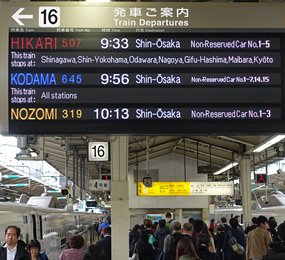
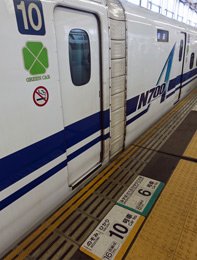
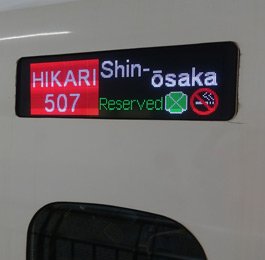
Luggage on Japanese trains
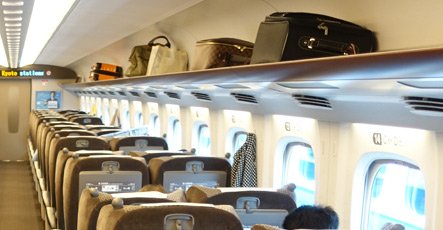
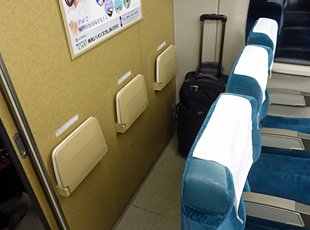
Luggage is no real problem on Japanese trains. Within reason, you can take what you like, nobody weighs it, measures it or argues about it. You simply take it with you onto the train and stick it on any suitable luggage rack. The overhead racks on shinkansen trains take anything up to backpack size. If you have a huge suitcase or don't want to lift heavy bags to the overhead rack, go to the back of your car and put your bags in the gap between the wall and the rearmost seats, as in the photo below right.
Rules for very large suitcases from 2020
Extra large luggage rules have applied to the Tokaido, Kyushu & Sanyo shinkansen lines since May 2020. Passengers with very large suitcases over 160 linear centimetres (linear cm = length + width + depth) will have to reserve a place for their suitcase at the same time they reserve their shinkansen seat, it's free of charge. But if they don't reserve, they face a ¥1,000 fine (about $8) on the train. It will no longer be possible to travel in an unreserved seats car with very large suitcases. The suitcases will go in behind the rear row of seats, or (when modifications are completed) in a new lockable luggage area which will replace some of the washbasins in designated cars. Obviously, the 160cm cut-off means this won't affect backpacks or normal-sized luggage, just over-sized cases. For more details see www.tsunagujapan.com/large-suitcases-shinkansen-policy.
Luggage lockers at stations
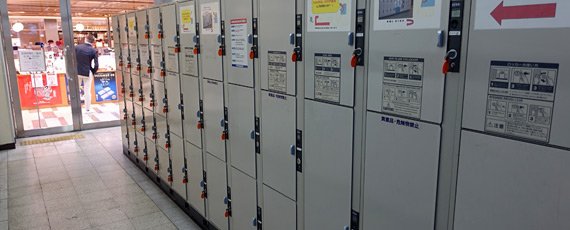
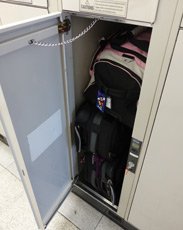
All principal stations have luggage lockers in various sizes in various locations. Expect a small locker to start at around ¥300 or ¥400, and you'll need coins. It's not usually difficult to find vacant lockers at any time of day. Below right, arriving in Himeji at lunchtime it was no problem to find a vacant large locker which took two backpacks and a holdall for ¥700. There's also a small staffed left luggage office at Tokyo station, inside the Marunouchi central entrance inside the JR Lines gated area.
Food on board: Eki-ben
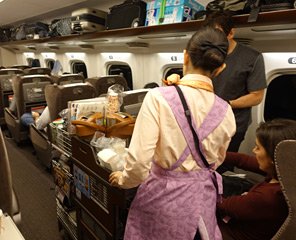
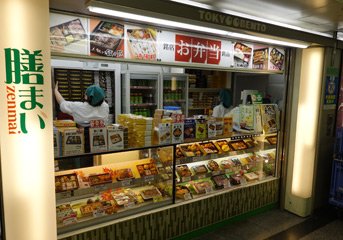
First the bad news. Japanese trains don't have restaurant cars or even a bar car, just vending machines and in some cases a refreshment trolley. The trolley on premier shinkansen trains such as Nozomi, Hikari, Mizuho or Sakura services sells tea, coffee, soft drinks, wine, beer, sake, snacks, small tubs of ice cream. The trolley accepts both cash and credit cards.
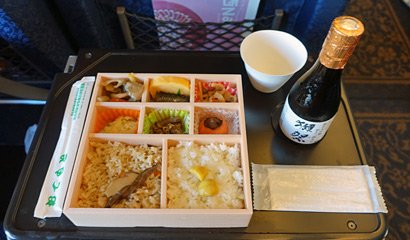
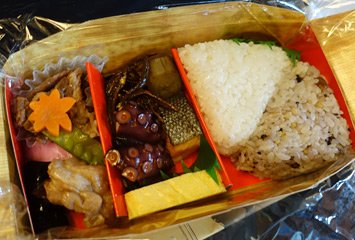
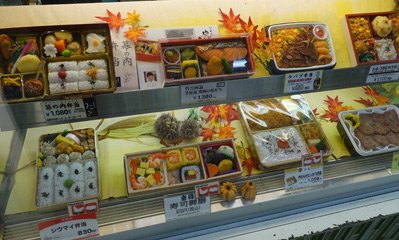
Now the good news. You can of course take your own food and drink onto Japanese trains, and one of the joys of Japanese train travel is the ekiben - eki meaning station, ben short for bento, meaning traditional Japanese packed lunch. Ekiben is sold at ekiben shops found at all main stations, and also from the refreshment trolley on principal shinkansen services. Ekiben comes in all sizes, shapes and qualities, but expect a decent large box to cost perhaps ¥800 bought at the station or ¥1,000 bought from the trolley on board a train. The ekiben boxes include chopsticks and finger wipes.
If you want to buy ekiben from the shinkansen refreshment trolley, just ask the trolley lady - she'll show you pictures of the what she has available in a little laminated menu booklet, just point to the one you want. You'll soon be a Black Belt in the ancient and honourable Japanese martial art of Eki-ben...
Power sockets & WiFi
You can reckon on finding power sockets for standard Japanese plugs at seats on almost all shinkansen and most limited expresses. Free WiFi is now available on most shinkansen routes including the Tokaido, Sanyo & Tohoku lines. Check your mobile provider for a data package for Japan, there is good mobile data reception along most shinkansen routes. You'll also find JR Free WiFi at a key stations including Tokyo, Shinagawa, Nagoya, Kyoto & Shin-Osaka.
Tokyo station: See location map
Tokyo's main central station is shown as plain Tokyo in timetables. Unlike most main stations worldwide, Tokyo station lacks a main entrance and main concourse. It's something of a rabbit warren, but as most visitors end up there sooner or later, here are some tips. You can read more about the station and its history at en.wikipedia.org/wiki/Tokyo_Station. It's the busiest station in Japan in terms of trains, though not in terms of passenger numbers.
-
The tracks run north-south through the city on a raised viaduct. So most platforms are one level up from street level, above the ticket offices, passageways and shops. However, platforms for the Sōbu & Keiyo Lines are underground, several floors below street level.
-
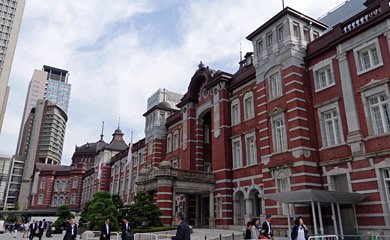
The west side of the station is called the Marunouchi side, and it features the historic station building built in 1915 and now beautifully restored, with it's upper floors housing the wonderful Tokyo Station Hotel. It's the quieter side of the station, close to the Imperial Palace.
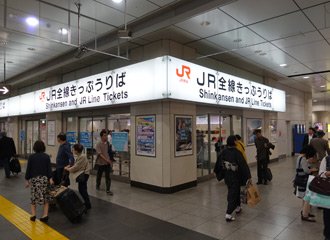
There are Marunouchi North, Central & South entrances, each with a row of ticket gates to access the JR lines (classic network) platforms 1-10. If you are catching a shinkansen, you'll need to pass through one of these gatelines and cross the JR Lines area to another set of ticket gates at the entrance to either the Tokaido/Sanyo shinkansen platforms 14-19 or the Joetsu, Tohoku, Hokuriku, Hokkaido/Yamagata & Akita shinkansen platforms 20-23. It's all well-signed in English.
-
The east side of the station is called the Yaesu side, it's modern and very busy and has what passes for a concourse - broad passageways with various JR & shinkansen ticket offices, shops & food outlets. The Yaesu side also has a North, Central and South entrance. On the Yaesu side you'll find a row of ticket gates at the entrance to the JR Lines area (platforms 1-10), another set at the entrance to the Tokaido/Sanyo shinkansen (platforms 14-19) and another at the entrance to the Joetsu, Tohoku, Hokuriku, Hokkaido/Yamagata & Akita shinkansen (platforms 20-23).
-
The north passage: A useful passageway connects the Marunouchi North entrance with the Yaesu North entrance, without passing through any ticket barriers - you'll also find lockers and cheap eateries along this passageway. If you want to get from one side of the station to the other without a Japan Rail Pass or other ticket, you'll need to use this North Passage.
Which platform?
-
The platforms are numbered 1 to 23, with platform 1 on the Marunouchi side of the station, platform 23 on the Yaesu side.
-
Platforms 1-10: JR Lines, the classic network. The useful Yamanote loop line around Tokyo leaves from platform 4 northbound to Ueno & Ikebukuro and platform 5 southbound to Shinagawa & Shibuya.
-
Platforms 14-19: Tokaido/Sanyo shinkansen to Kyoto, Shin-Osaka, Himeji, Hiroshima, Kobe, Hakata.
-
Platforms 20-23: Joetsu, Tohoku, Hokuriku, Hokkaido/Yamagata & Akita shinkansen heading north & east from Tokyo.
-
Sōbu Line platforms 1-4, several levels underground on the western side of the station. Narita Express & local trains.
-
Keiyo Line platforms 1-4, also underground, served by local trains.
Tokyo Station, Marunouchi side
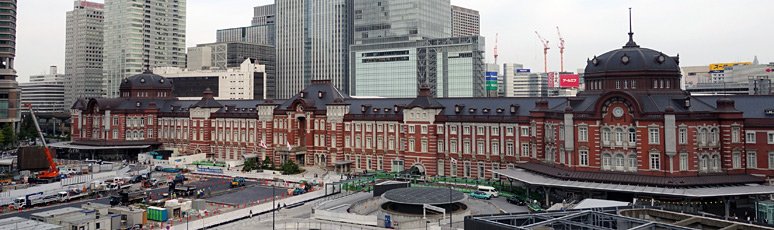
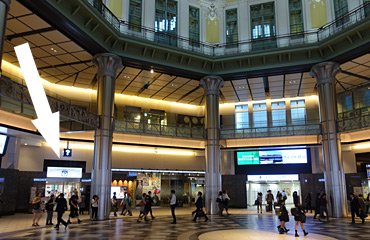
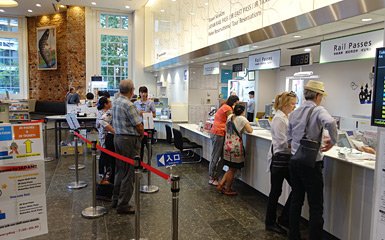
Tokyo Station, Yaesu side
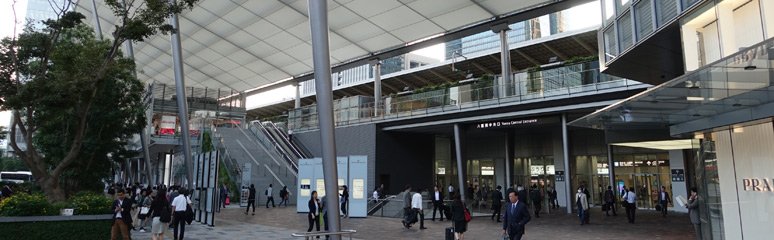
How to buy local tickets
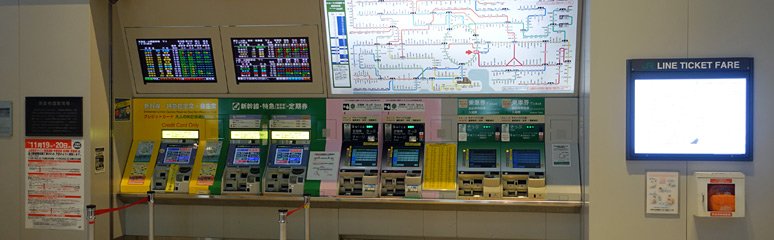
Buying local tickets in Tokyo. There's a row of ticket machines like this near every entrance to the platform area.
The yellow & green machines on the left sell Shinkansen & Limited Express reserved & unreserved tickets & reservation changes.
The pink or green machines on the right can sell local tickets in the Tokyo area. The map above the machines shows the price to each station on the local network from the station you're at, you simply select that price on the machines, see the How to buy tickets section above for more details.
One-day metro & local train passes for Tokyo: There are 1-day passes you can get to cover either metro trains or metro trains + JR local trains in the Tokyo area. You need to clock up perhaps 5 or 6 journeys in a day to make one of these worthwhile. See www.tokyometro.jp/en/ticket/value/1day.
The Tokyo Station Hotel: Check prices
The lovely 5-star Tokyo Station Hotel is another unique place to stay that deserves a special mention, even if (unlike capsule hotels) it's not a budget option! The hotel occupies the 2nd & 3rd floors of the historic and beautifully-restored 1915 station building on the quieter Marunouchi side of Tokyo station. Given that so many of Tokyo's classic hotels have been destroyed by earthquakes or wartime bombing then rebuilt as modern tower blocks, this has to be one of the most historically-interesting places to stay. It's a luxurious and well-located choice, too, with a first-rate breakfast buffet served in the Atrium located inside the large central pitched roof above the 3rd floor. And it's so handy for the trains.
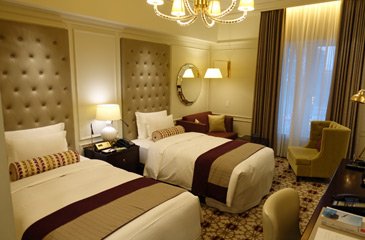
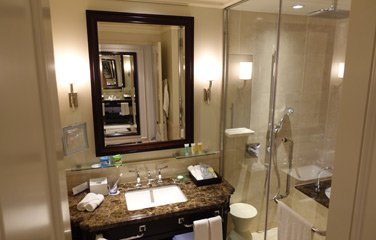
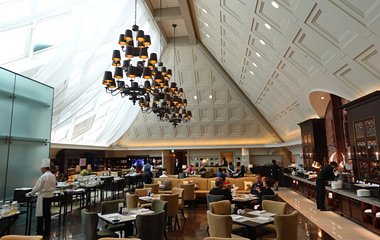
Any visit to Japan is a cultural experience. Don't just stay in western hotels and visit the sights. Make the places you stay part of the experience, by staying in a traditional Japanese ryokan, or even a capsule hotel.
Ryokans
Ryokans are traditional Japanese inns. The rooms don't have beds, the floor is covered with tatami matting on which you place a bedroll. You may be offered a hot cup of green Japanese tea when you first arrive. You can sometimes find ryokans online on hotel booking sites such as www.booking.com. The very best and most famous ryokans can be fabulously expensive, but cheaper ones can be a budget option. Search for Ryokans in Tokyo. Search for Ryokans in Kyoto.
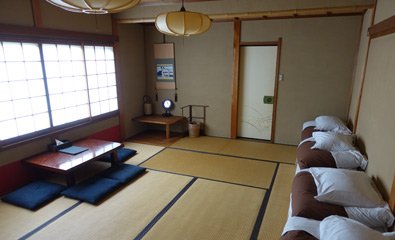
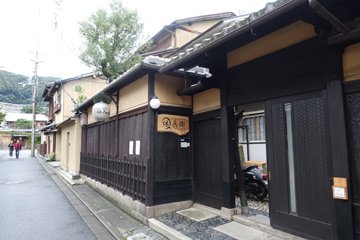
In Kyoto, the excellent Gion Ryokan Q-Beh (pictured above) is 10-15 minutes walk from the Kyomizu-dera temple, 10 minutes walk from the Gion Geisha district. It has budget dorm rooms and private rooms, and free WiFi. The photos above show a family room with shower & toilet.
In Hiroshima, try the Chizuru Ryokan, 10 minutes walk from the Peace Park.
Capsule hotels
Another classic Japanese experience is to spend a night in a capsule hotel - which coincidentally is also a money-saving option for staying a night in the heart of Tokyo or another big city. These are more civilised than you might think.
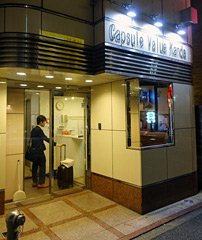
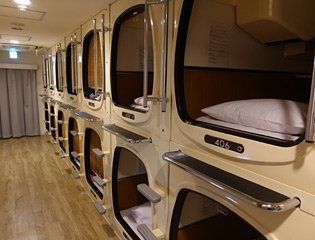
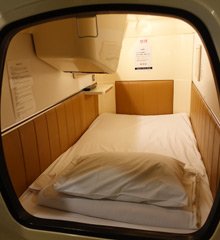
The hotel reception looks like any other hotel reception. Remember to take your shoes off before you walk in, and place them in one of the lockers in the lobby. Upstairs, there will probably be several floors of fibreglass sleeping capsules, each floor with its own locker room and shared showers. You change in the locker room and put your clothes and bags into your locker. Your capsule has radio, alarm clock and TV, and a screen or curtain pulls over the capsule entrance for privacy. The main drawback is that the main clientele for these hotels is Japanese businessmen who have missed their last train home, so capsule hotels are usually male-only. But capsule hotels for women do exist. The pictures below show end-entry capsules, but some capsule hotels have side-entry types, and you'll now find some capsule hotels with larger, more hotel-style capsules too.
You can usually walk into a capsule hotel and ask for a bed for the night, but if you want to pre-book this unique experience, try the Capsulevalue Kanda in downtown Tokyo near Kanda station, one stop north of Tokyo station, a bed in downtown Tokyo for as little as ¥3,400 (about £26 or $32) per night. Men and boys over 10 can stay there, but not women or children.
Haneda Airport to Tokyo
-
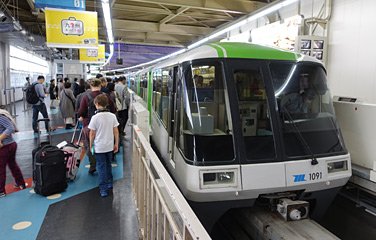
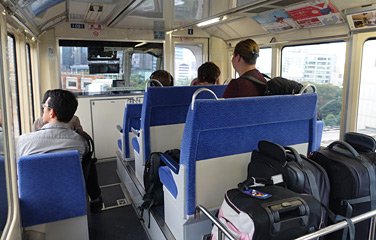
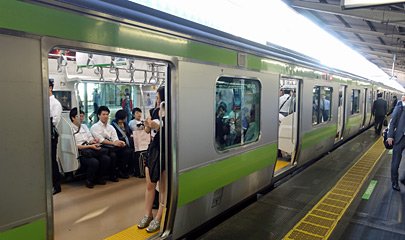
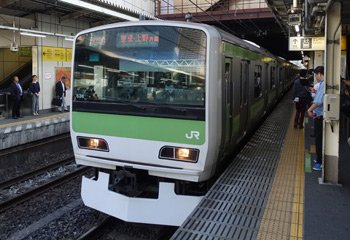
The cheapest & easiest way from Haneda Airport into Tokyo is to take the monorail from Haneda Airport International Terminal to Hamamatsucho station and change onto the JR Yamanote line to Tokyo station. The monorail and JR local trains run every few minutes, total journey time from Haneda Airport to Tokyo station is only around 20 minutes.
-
For fares & info see www.tokyo-monorail.co.jp.
-
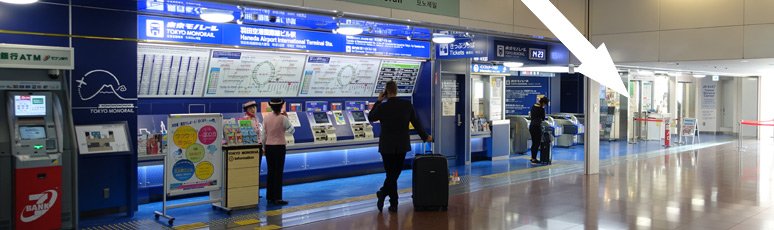
Emerging into the Haneda Airport International Arrivals hall, follow the signs to the Monorail which is just a few metres straight ahead of you.
Buy a ticket from the row of machines at the monorail entrance as follows: First look at the map above the machines and locate your destination station, let's say Tokyo station. Note the price shown against that station. On the touch screen, press English then press JR Transfer as you want a combined Monorail + JR local train ticket. Then select the number of passengers and the relevant price on the screen. You'll need coins or notes, the machines don't take cards.
-
Japan Rail Passes cover both the Tokyo Monorail and JR local trains, so you can use your pass to travel to and from the airport if you like. But as the journey doesn't cost very much, don't waste a valuable pass day on such a short journey unless you have pass days spare. Arriving at Haneda Airport International Terminal, you can exchange your voucher for a Japan Rail Pass at the JR East Travel Service Centre next to the entrance to the monorail platforms, marked by the arrow in the photo below.
Narita Airport to Tokyo
Option1, Narita Express to Tokyo main station
-
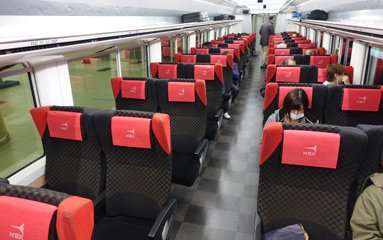
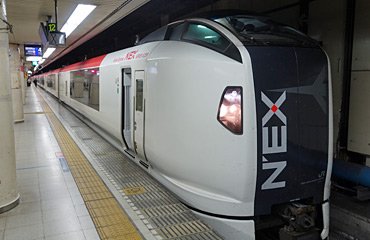
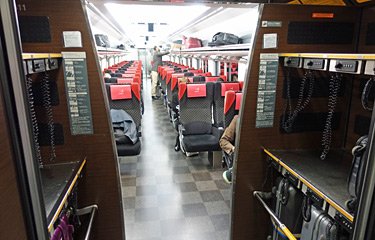
The Narita Express is a dedicated airport train that runs from Narita Airport Terminal 1 & Narita Airport Terminal 2 non-stop to Tokyo station in the heart of Tokyo. It runs every half hour or so through the day taking 59 minutes. Just buy a ticket at the station. The train has ordinary class and green car, all seats are reserved and all tickets come with an allocated seat.
-
For times & prices see world.jorudan.co.jp/mln/en/ or see www.jreast.co.jp/e/nex.
-
Tip: The Narita Express uses the underground Sōbu Line platforms at Tokyo station. These are numbered 1-4, but they should not be confused with the regular platforms 1-4 above ground.
-
Japan Rail Passes cover the Narita Express, but when arriving by air at Narita you'll first need to exchange your voucher for the actual Japan Rail Pass. There are Japan Rail Pass exchange counters at both the ticket office and the Travel Service Centre at both the Narita Terminal 1 station and Narita Terminal 2 station.
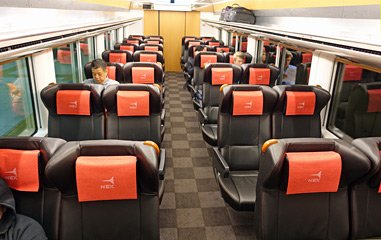
Option 2, Keisei Skyliner from Narita to Ueno station
-
Alternatively, the Keisei Skyliner links Narita Terminal 1 & Terminal 2 with Tokyo's Ueno station. This also runs every half hour or so, also non-stop, journey around 45 minutes to Ueno, it's a fraction cheaper than the Narita Express and also all-reserved. For times & prices see world.jorudan.co.jp/mln/en/. However, the Keisei Railway is a private non-JR railway so Japan Rail Passes cannot be used on it.
-
You can buy Keisei Skyliner tickets online in advance at www.klook.com. You get an open-date voucher.
Cheaper options
-
If you are counting every penny, you can more than halve the cost of airport transfers by using local or rapid trains between Narita and Tokyo rather then the Narita Express or Keisei Skyliner, changing at Chiba. It'll take 30-45 minutes longer than using the Narita Express or Skyliner. To find train times, use world.jorudan.co.jp/mln/en/.
-
You can travel from London to Tokyo in just 12-14 days by Trans-Siberian Railway for roughly £800 in round figures.
Update 2024: War in Ukraine & sanctions on Russia currently make this route impractical. Moscow-Beijing trains are suspended.
-
Option 1, via Vladivostok
- Travel from London to Moscow, see the London to Russia page. This takes 48 hours using the Paris-Moscow Express.
- Take the Rossiya from Moscow to Vladivostok, this runs every second day taking 7 days, see the Trans-Siberian page.
- Take the ferry from Vladivostok to Sakaiminato in Japan, sailing once a week taking 36 hours, see the Vladivostok-Japan ferry section.
-
Option 2, via Beijing & Shanghai
- Travel from London to Moscow, see the London to Russia page. This takes 48 hours using the Paris-Moscow Express.
- Travel from Moscow to Beijing on one of two weekly Trans-Siberian trains, taking 6 days, see the Trans-Siberian page.
- Take an overnight or high-speed train from Beijing to Shanghai (see the Beijing to Shanghai page).
- Take one of the two weekly ferries from Shanghai to either Osaka or Kobe in Japan, see the China to Japan ferry section.
-
Going via Vladivostok is simpler to organise as you need fewer visas, but going via Beijing more varied and interesting, and the one I'd recommend.
Ferries between Japan & China, Korea, Vladivostok
-
For the weekly ferry from Sakaiminato in Japan to Vladivostok in Russia, see the Trans-Siberian page.
-
For ferries between Japan and Shanghai in China, see the China page.
-
For ferries between Japan and South Korea, see the Korea page.
 Tours
of Japan by train
Tours
of Japan by train
If you want a tour agency to organise a tour of Japan for you with train travel, transfers & hotels included as a package, Railbookers specialise in train-based tours and have several suggested tours of Japan by rail, including Best of Japan, Scenic Japan and Golden Route of Japan. These can be adjusted to your specification.
 UK call 0207 864 4600,
www.railbookers.co.uk.
UK call 0207 864 4600,
www.railbookers.co.uk.
 US call free 1-888-829-4775,
www.railbookers.com.
US call free 1-888-829-4775,
www.railbookers.com.
 Canada call free 1-855-882-2910,
www.railbookers.com.
Canada call free 1-855-882-2910,
www.railbookers.com.
 Australia call toll-free 1300 971 526,
www.railbookers.com.au.
Australia call toll-free 1300 971 526,
www.railbookers.com.au.
 New Zealand call toll-free 0800 000 554 or
see
website.
New Zealand call toll-free 0800 000 554 or
see
website.
Guidebooks
Japan by Rail & Lonely Planet guides: In the age of the internet, a printed guidebook may seem an unnecessary expense, but you'll see so much more and know so much more about it if you have a decent pocket guidebook. The Trailblazer Japan by Rail guide is specifically aimed at train travel around Japan, with both city and train information - highly recommended! Other than that, for the serious independent traveller, the best guidebooks to take are either the Lonely Planet or the Rough Guide. I personally prefer the layout of the Lonely Planet, but others prefer the Rough Guides. Both guidebooks provide excellent levels of both practical information and historical background.
Click the images to buy online at Amazon.co.uk
Flights to Japan
Overland travel around Japan by train is an essential part of the experience, so once there, don't cheat and fly, stay on the ground! But a long-haul flight might be unavoidable to reach Japan in the first place.
1) Check flight prices at Opodo, www.opodo.com
2) Use Skyscanner to compare flight prices & routes worldwide across 600 airlines...

Travel insurance & other tips
|
|
|
|
|

Always take out travel insurance
Never travel overseas without travel insurance from a reliable insurer, with at least £1m or preferably £5m medical cover. It should also cover cancellation and loss of cash and belongings, up to a sensible limit. An annual multi-trip policy is usually cheaper than several single-trip policies even for just 2 or 3 trips a year, I have an annual policy with Staysure.co.uk myself. Here are some suggested insurers. Seat61 gets a small commission if you buy through these links.
www.staysure.co.uk
offers enhanced Covid-19 protection & gets 4.7 out of 5 on
Trustpilot.
www.columbusdirect.com
is also a well-know brand.
If you live in the USA try
Travel Guard USA.
|
|

Get an eSIM with mobile data package
Don't rely on WiFi, download an eSIM with a mobile data package for the country you're visiting and stay connected. Most newer mobile phones can download a virtual SIM card so you don't need to buy a physical SIM, including iPhone 11 & later, see device compatibility list. Maya.net is a reliable eSIM data retailer with a 4.5 out of 5 Trustpilot rating and a range of packages including unlimited data.
|
|


Get a Curve card for foreign travel
Most banks give you a poor exchange rate, then add a foreign transaction fee on top. A Curve MasterCard means no foreign transaction fees and gives you the mid-market exchange rate, at least up to a certain limit, £500 per month at time of writing. The money you spend on your Curve card goes straight onto one of your existing debit or credit cards.
How it works: 1. Download the Curve app for iPhone or Android. 2. Enter your details & they'll send you a Curve MasterCard - they send to the UK and most European addresses. 3. Link your existing credit & debit cards to the app, you can link up to two cards with the free version of Curve, I link my normal debit card and my normal credit card. 4. Now use the Curve MasterCard to buy things online or in person or take cash from ATMs, exactly like a normal MasterCard. Curve does the currency conversion and puts the balance in your own currency onto whichever debit or credit card is currently selected in the Curve app. You can even change your mind about which card it goes onto, within 14 days of the transaction.
I have a Curve Blue card myself, it means I can buy a coffee on a foreign station on a card without being stung by fees and lousy exchange rates, just by tapping the Curve card on their card reader. The money goes through Curve to my normal debit card and is taken directly from my account (in fact I have the Curve card set up as payment card on Apple Pay on my iPhone, so can double-click my phone, let it do Face ID then tap the reader with the phone - even easier than digging a card out). I get a little commission if you sign up to Curve, but I recommend it here because I think it's great. See details, download the app and get a Curve card, they'll give you £5 cashback through that link.
|
|

Get a VPN for safe browsing. Why you need a VPN
When you're travelling you often use free WiFi in public places which may not be secure. A VPN encrypts your connection so it's always secure, even on unsecured WiFi. It also means you can select the geographic location of the IP address you browse with, to get around geoblocking which a surprising number of websites apply. See VPNs & why you need one explained. ExpressVPN is a best buy with a 4.7 out of 5 Trustpilot ranking which I use myself - I've signed up as an ExpressVPN affiliate, and if you go with expressvpn.com using the links on this page, you should see a special deal, 3 months free with an annual subscription. I get a small commission to help support this site.
|
|

Carry an Anker powerbank
Tickets, reservations, vaccination records and Interrail or Eurail passes are often held digitally on your mobile phone, so it's vital to keep it charged. I always carry an Anker powerbank which can recharge my phone several times over if I can't get to a power outlet. Buy from Amazon.co.uk or from Buy from Amazon.com.